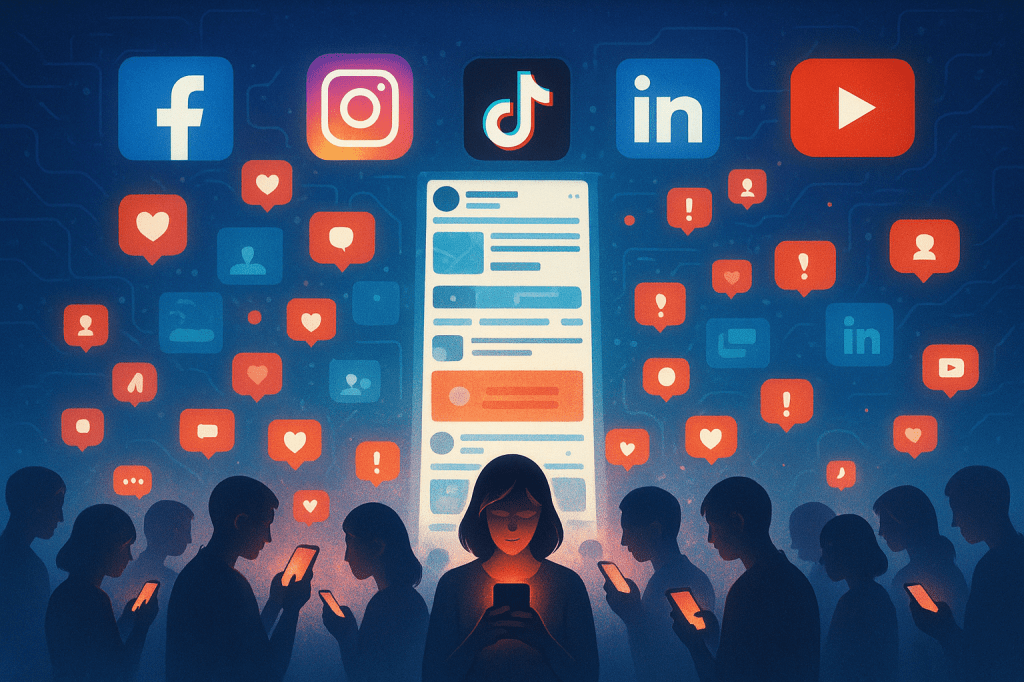
I don’t think it’s a secret that things aren’t going so well, society is and has been crumbling for some time, and human behaviour has become extreme in recent years. There are plenty of theories and opinions about whether society as we know it is on a decline. That we’re living in a matrix like simulation that is breaking or that perhaps what we’re living through is not so much of a crumbling, but rather a re-imaging of the future, and everything else in between.
I’ve explored many of these theories, but I keep coming back to my own observations. I believe the downfall of society, particularly in the west is due to three things.
- Social Media
- Direct Messaging
- Straight people accessing online dating platforms.
- Social Media
Social media and its role in the modern world is something that will be debated until the end of time. The effects of social media on the human brain have been and continue to be studied, and I’ve no doubt will be for years to come. Allow me to tell you about the moment the alarm bells rang for me.
For over a decade, I worked in the youth homelessness sector. I worked mainly in crisis services where we provided short term accommodation for young people aged 12-25 experiencing homelessness. This was not that long ago, II started around 2008 as part of my placement during my undergraduate studies in Social Science. Back then, it was not uncommon for young people to get into physical altercations daily in these services, and a lot of the job was purely keeping distance between young people to avoid fights breaking out. There was a lot of energy I guess you could say in these environments, but what I will say is that you knew exactly what you were dealing with because it was playing out right in front of you, and the training was available to us as workers to deal with it, and it was effective.
I clearly recall the moment the fights stopped. It was towards the end of 2011/beginning of 2012, something in the air changed. I noticed a sharp reduction in the frequency of physical altercations; however, the behaviour I’d come to expect post an altercation was still presenting. Then something else happened, seemingly out of nowhere, huge fights would erupt, involving more people all at the same time, even people who were not residing in the service. The game had changed, and there was no rule book.
By this time, I’d been working for the same service for almost 3-4 years and had gotten to know some of the regulars who couch surfed as a lifestyle and when that option expired, came back to us. So, I talked to them about what I was seeing and was concerned at what they told me. I won’t lay blame on a particular social media platform, but it was only one causing the issues, and by this I mean it was the one the young people were using the most and turned out to be the one where the bullying and antagonising of each other was occurring. It was here the momentum was building before the ultimate outcome, the fights, but to be honest with you, the fights were the easiest to deal with. It all started to make sense, the verbal altercations we were used to hearing that led to fights had stopped, because the threats had shifted from words between two people, to messages being sent online, they’d become invisible and were having a far more sinister impact than ever before. There was momentum building up that was out of sight, leading to more explosive and extreme offline behaviour.
Humans have had access to ways of communicating with each other aside from speech for thousands of years. Communication via the written word, via art and music have arguably led us to great things throughout history. What has differed since the advent of social media is the amplification of nastiness, and the inclination to go one step further when anonymity enters the chat. People are far more inclined to say and do what they really feel like saying and doing when there is the possibility of not being found out, or held accountable, and it’s only a good thing that the law in recent years has caught up.
- Direct Messaging
Now seems like a good place to leave social media there, and segue into Direct Messaging, which is essentially a byproduct of social media.
Before the advent of the internet, it would not be a stretch to say that many of us grew up in either small towns, or in the suburbs of cities. We didn’t stray too far from home, and a holiday was often a short trip to a beach side town not far from where we lived. From birth through death, the number of people we met and went through life with was perhaps much smaller than it is now, and we mostly only knew life as it was presented to us, with far less exposure to other parts of the world.
Writing letters or writing into magazine or TV shows became a thing. If we wanted to reach our favourite celebrity, we could maybe find through extensive research a way of writing to them, or maybe even a phone number to their production company, but it would have been an international call and that cost a lot of money, so we didn’t do that, besides, we got in trouble. If we saw someone we didn’t know when we were out and about, as we often were, and they seemed interesting or maybe we had a crush on them, we had limited options. We either went up to them and started a conversation, we did nothing and lived for a few days or weeks in the fantasy, or we hoped they would approach us and that it would lead to love and living happily ever after. I’m generalising but you get the gist.
Direct Messaging, or Instant Messaging as it is also known began sometime in the 1960’s, leading to the creation of a government application called EMISARA in 1971 by Murray Turoff. However, it was not until the mid 1990’s where this technology made its way into the mainstream. AOL Instant Messenger (AIM) and Yahoo! Messenger entered our lives in 1997-98, making instant messaging an omnipresent part of daily life. It’s important to note here, that these services were primarily available on computers that were restricted to one location, like the computer room in the family home that we look back on with nostalgia. In 2005, BlackBerry Messenger became the first popular example of mobile-based instant messaging, combining features of traditional instant messaging and mobile SMS (texting).
It’s difficult to get a definitive number of how many people are using instant messaging platforms today, but to illustrate an example of the more dominant platforms; WhatsApp is the world’s most popular messaging app with around 3 billion monthly active users, followed by WeChat (1.34 billion) and Facebook Messenger (over 1 billion). That’s a lot of people communicating with each other online, not saying actual words out loud for others to hear, it’s a lot of unseen and unheard communication. Referring to my earlier example of when the fights stopped in the homelessness service I worked at, I think you can see where I’m going with this.
Communication has and will continue to evolve, peoples understanding of new ways of communicating, both inbound and outbound will also continue to evolve, but not at pace with the technology, there is a lag, a disconnect if you will. There will be early adopters, and there will be those left behind. The fact is I suppose, instant messaging has been around for some time now, and shows no sign of slowing down, but I’d argue the for all the good it’s done in assisting us to build the world we now know, and to learn about ways of life and things going on we’d ordinarily not know about, we cannot turn a blind eye to the harm caused.
Having the ability or dare I say privilege to communicate with anyone and everyone online whether we know them or not, well, there is a for and against. Just some of the fors are that people who would have ordinarily not had access to education or information or even employment do so thanks to the online world and instant messaging. The against, well, there are many examples but one I’ll reference as part of perhaps pop culture as it takes me to my third point is The Tinder Swindler.
- Straight people accessing online dating platforms.
As with instant messaging, online dating traces its roots back to the mid 1960’s with Operation Match. I’m sure there were others, but using this as an example, Operation Match was the first U.S computer dating service that began matching users with potential partners based on questionnaires they’d completed. In the 1970’s through to the 1980’s, the technology behind Operation Match influenced other online dating services such as dateline, which was quite popular at the time, and later this landscape evolved into one perhaps more known, Match.com.
A notable difference in the approach of Match.com was the conversion of computerized matchmaking into a profitable business. Towards the end of the 1990’s, the widespread use of the internet at large allowed online dating to become more accessible, and more acceptable to the public.
In 2007, the game changed again, and as with any game change, no one wrote the rule book. A consistent theme with technology seems to be we the average person are live testing new platforms as paces we’re not wired to operate at. The real life and long-lasting consequences never seem to enter the equation, nor are the billions of dollars generated by tech companies used effectively in addressing the damage they cause, but that’s for another day. The introduction of smartphones enabled location-aware apps such as Grindr, making dating accessible everywhere, further transforming the online dating landscape. In 2012, Tinder was launched, igniting major growth in mobile dating apps, changing the game once again, and feeding into a storm much larger than online dating itself.
And here we are, the perfect storm that erupted sometime in 2012. With just the three examples discussed here today, I believe the downfall of society as we know it can be traced back to the almost synchronised release, or rather amplification of these technologies. Some 1 in 4 Australians under 44 meeting a partner online, and while global usage is high, with over 50 million users on apps like Tinder, success rates can be low, and safety concerns are widespread, with nearly 75% of Australian dating app users experiencing online harassment.
We’ve established that online dating is not new, and we’ve established that it’s been rather successful for some time now, presumably among straight people. However, I’m not convinced, and purely because I’ve been studying this for some time now, I’ve been talking to people, and I’ve got my own lived experience.
Let’s begin.
I’ll start by using a provocative baseline to set the scene of the point I am wanting to get across. Straight people for the most part seek to find a mate to procreate with. Yes, there is a lot more to straight people than this, but for the purposes of the argument let’s go with this. It’s been my experience that straight people are just not hard wired to play around with dating, with instant messaging, with shallow situationships and with casual encounters. There are maybe studies out there to argue both sides but for the time being, I’m exploring a theory here and am not ignorant to the fact that it might not go down well.
It seems to be that mobile instant messaging and being available online always regardless of location, irrespective of the content of the messaging has some downfalls. It’s led to the creation of a subculture that only a few years ago did not exist, and it could be argued either way in terms of evolution that this was always the way it was going to go. I can’t quite make my mind up on that one.
Moving on and using the above example of where Grindr entered the chat circa 2007, the game changed. Gay men have been using online dating sites for many years. For a lot of us, it was the only way we could access other men experiencing the same things we were. A lot of us were brought up in worlds dominated by straight people, straight culture, societal norms that did not emulate what we were feeling to be true, so we needed somewhere to go. It was a dangerous place in the early days, late nights chatting to strangers, agreeing to meet up in either their houses, or public places for encounters, with no one knowing where we were or what we were up to. We knew the risks, and we took them anyway, we’re wired different. To live life outside of societal norms takes courage, it takes strength, it changes the way you think and how you approach daily life. It requires the ability to enter and navigate situations most people could not fathom, it hard wires us for this type of life.
It is with this hard wiring that we learn how to play the game if for no other reason than we created it. It was one of the last secret worlds we had, and then in 2012 when it went mainstream, we lost it, and the straights blew it up, and things became a mess. Not only did it become a mess, but it generated a lot of profit, and profit is something that a select cohort of the population love, for they seldom have anything to do with how it’s being generated, nor do they care. But for those of us living it, we’re left with the cleanup job, and it’s never ending. It’s a culture of main characters, it’s a legal system choking, its real-life situations playing out on our screens for dramatic purposes, all of course generating profit, it’s content, and we’re doing nothing more than consuming it.
What does this all mean?
The human experience is one of the most glorious and unique we’ll ever know. We only get to do it once; time is a non-renewable resource. There is so much to see and do and I’ve no doubt that many of us are out there every day seeing and doing as much as we can. But if I was to draw a conclusion regarding the downfall of society from the three topics I’ve chosen to talk about today, it would be this.
As a collective, we’ve diminished the human experience down to social media content, direct messaging and ill-fated lust. It’s not much more than that. Yet we’ve attached so much meaning to things that are just so meaningless, using our one-off allocation of time on pointless interactions and activities, that take away more than they add if we’re being honest, it’s madness and it’s gone too far.
But things are changing. Every generation faces its own set of challenges, and you could argue that the last ten or so years have presented and continue to present more than our fare share. We’re at a boiling point of sorts, whereby the way we are living life and the way we’re interacting with each other for the most part, simply is not working anymore. We’re better than this, our experience here in this life is short, and can be filled with such wonder, it’s more than content, it’s more than sliding into someone’s DM’s, it’s more than swiping carelessly through a dating app, so let’s be honest with ourselves and each other and be better, it’s as simple as that.
I’ll finish with this, I’m not ignorant to the fact that I’ve perhaps picked the low hanging fruit to base a theory that society is crumbling down around us, I’m aware there is more to it. There are far greater atrocities occurring daily in this world than direct messaging going haywire. My point is, using these examples, things have gotten out of hand, and it all happened quite fast, faster than I think anyone could have imagined, and the solutions are there, we just all must be a little more honest with ourselves. Sure, we don’t all have to go on and create the next Mona Lisa, or compose music, but we each have a role to play in being just a little bit kinder, and more thoughtful towards others. It’s a privilege to wake up each day in the west and live the way we do, and to be honesty, it’s disrespectful to carry on the way we’re carrying on. Sure, things could always be a lot better, but at the same time, they could also be a lot worse, so it’s up to us to choose our next move carefully and consider the long-lasting impacts of that move. Ask questions, click the second page on the google search, follow the money. For as careless and uneducated as some decisions of those leading us appear to be right now, we the people are more educated and aware than ever before and have the tools at our disposal to use for good, and not evil, so therein lies the choice.
Do I really believe that straight people accessing online dating websites and apps is one of the three causes of the downfall of society? Well, I’ve stated yes and I’ve argued my point, but of course parts of my argument are tongue in cheek and intentionally provocative to evoke an emotional response, so why would I do that? It’s simple. I’ve been in human services for over two decades and I’ve learned a thing or two in that time about people. One thing is that if you don’t hit people where it hurts with the truth, right there in the centre of the chest where the rage rises, then you rarely get anywhere when it comes to inciting change. If you felt something earlier, good, I’m glad, it means I hooked your attention. All I’ve done here today is write some words based on years of experience and observations, what you do with these words is on you.
All the best.


 Scanphilosophy
Leave a comment